Early Childhood Education: What Makes a Great Early Childhood Education Program in Mandurah?
Choosing where your child spends their early years is a big decision. You want somewhere they feel safe and happy, and somewhere they'll also learn. With so many options, it's hard to know what a good early childhood education program looks like in practice.
The first five years are when children form their first friendships and learn to share, communicate and try new things. This guide covers what early childhood education involves and what to look for when choosing an early learning centre in Mandurah.
What Is Early Childhood Education?
Early childhood education is the learning and development children experience from birth to five, through play, relationships and everyday routines. It happens in a planned, thoughtful way with qualified educators, which sets it apart from simple supervision.
Childcare helps families work and manage the week. A quality early childhood education program does that too, but it also supports children's social, emotional, physical, communication and thinking skills. A child who learns to wait for a turn, ask for help or describe a drawing is building skills they'll use for years.
Why Early Childhood Education Matters in the Early Years
Young children learn from the people around them and the things they get to do. Warm relationships with educators help children feel secure enough to explore, and that security makes them more willing to try new things.
Early learning also builds practical skills. Children practise talking and listening, solving small problems and doing things for themselves, like pouring a drink or packing away. None of this guarantees a particular result later on, but it gives children confidence and habits that make new situations easier.
What Should a Quality Early Childhood Education Program Include?
A good program has a few things in common, whichever centre you visit:
Play-based learning, where children learn by doing, not by sitting at a desk.
Child-led exploration, so children's interests guide what happens.
Intentional teaching, where educators plan activities and step in at the right moment to extend learning.
Age-appropriate experiences that suit where each child is at.
Social and emotional learning, such as making friends and managing big feelings.
Communication and language, through conversation, songs and stories.
Creativity and physical development, with art, music, movement and active play.
Independence, from self-care routines to making choices.
Meaningful educator-child relationships.
Indoor and outdoor learning, every day.
Family involvement in what the program looks like.
School readiness, built gradually through all of the above.
Learning Through Play
Play looks simple, but it does a lot of work. When children play, they test ideas, negotiate with friends and practise skills in a way that makes sense to them.
Here's what that can look like on an ordinary day:
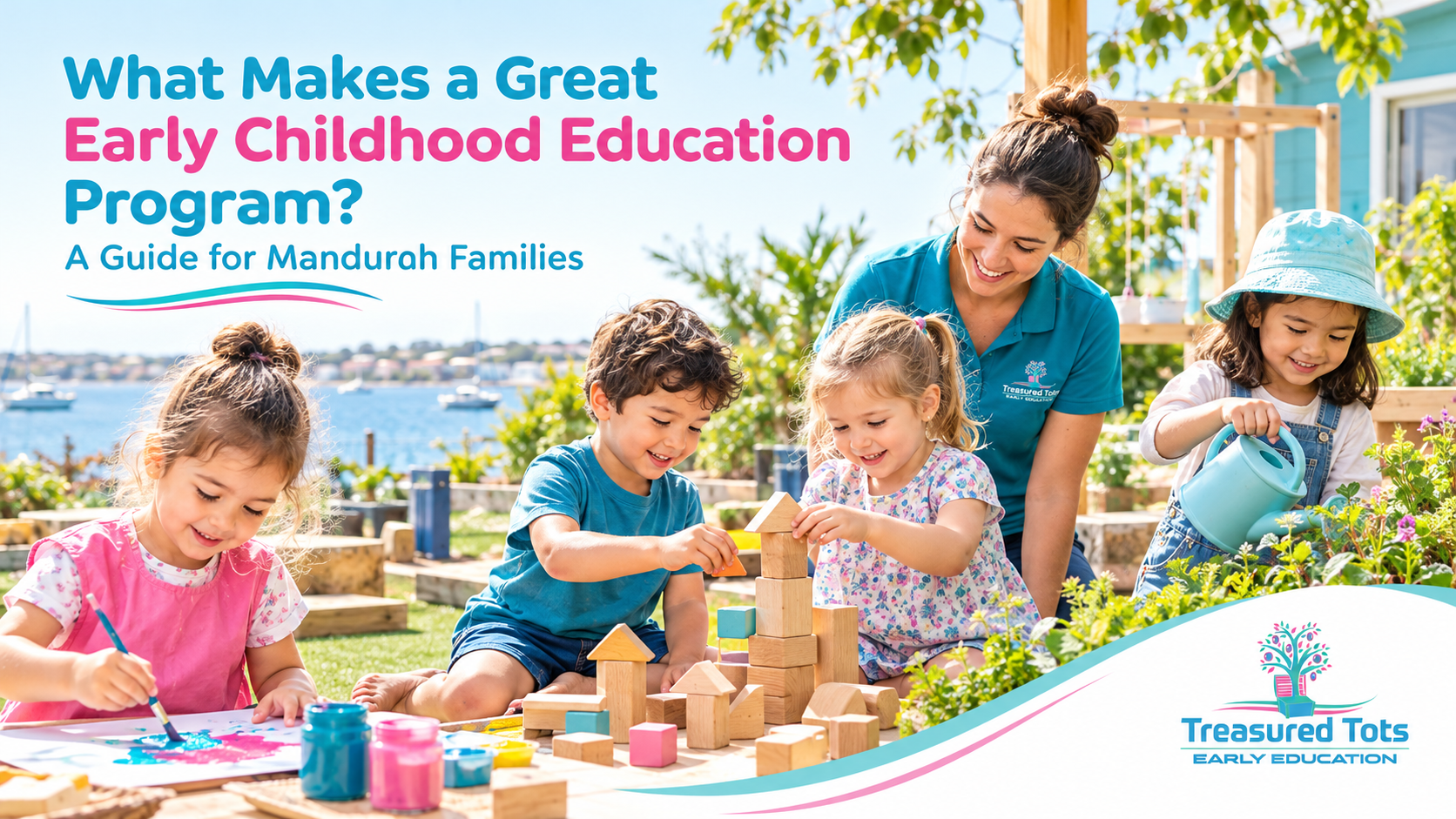
Building: Stacking blocks teaches balance, planning and persistence when the tower falls.
Drawing and painting: Children express ideas, build fine motor control and talk about what they've made.
Storytelling and dramatic play: Pretending to run a shop or a vet clinic builds language, empathy and turn-taking.
Music and dance: Singing and moving help with rhythm, memory and self-expression.
Gardening: Planting and watering teaches patience and care for the environment.
Group activities: Working together on a shared project teaches children to listen and cooperate.
At home, you can support this with simple things like reading together, letting your child help in the kitchen, or heading to the foreshore and talking about what you see.
How the EYLF Supports Early Learning in Australia
Early learning centres across Australia work with the Early Years Learning Framework (EYLF), which guides programs for children from birth to five. It's built around three ideas:
Belonging: feeling connected to family, community and the centre.
Being: enjoying childhood and being present in the moment.
Becoming: growing, learning and changing over time.
Educators use the framework to observe each child, notice their strengths and interests, and plan experiences that build on them. In practice, it means a program that responds to your child, not a one-size-fits-all timetable.
What Does an Early Childhood Education Program Look Like in Mandurah?
Mandurah families are lucky to have water, parks and open space close by, and a good program makes the most of that kind of environment. When comparing early learning options, it helps to look at the whole day, not just the building. Consider the learning environment, how educators interact with children, the balance of play and planned learning, the routines, the resources on offer, and how individual children are supported.
Treasured Tots Early Education is one example of a centre shaping its program around these ideas. Its approach brings together children's interests, family input and intentional teaching, with room for children to explore and discover through play. Each day includes visual arts, singing, dancing, musical play, dramatic play, and indoor and outdoor experiences. Sustainability is part of everyday learning, so children are encouraged to care for the environment around them.The curriculum isn't just the activities. It's also the relationships, interactions, resources, routines and physical environment working together. That's a useful lens when you're visiting any centre.
How Parents Can Choose the Right Early Learning Centre in Mandurah
A tour is the best way to get a feel for a place. Take this list with you:
How are children's interests included in the program?
What does a typical day look like, and what role does play have in it?
How do educators communicate with families?
What opportunities are there for indoor and outdoor play?
How is learning documented and shared with parents?
How are individual needs, strengths and learning styles supported?
How does the centre approach school readiness?
How do educators interact with children, and do the children seem relaxed and engaged?
Why Family Involvement Matters
You know your child better than anyone. You know what they talk about at dinner, what makes them laugh and what worries them. When educators hear that, they can plan learning that actually means something to your child.
Good communication works both ways. Educators share what children are exploring, and families share what's happening at home. Treasured Tots, for example, invites input through its OWNA app and "all about me" forms. A new interest in dinosaurs or a recent family holiday can become the starting point for a week of learning.
Helping Children Become Confident Learners
Confidence grows through small wins: finishing a puzzle, joining a group game or saying "I can do it myself." A strong early childhood education program gives children plenty of those moments.
When educators encourage curiosity, value children's ideas and let them try things independently, children learn that their thoughts matter. They get used to asking questions, having a go and trying again. That attitude is worth more than any single skill when school starts.
Finding the Right Fit for Your Family
The right early childhood education program is one where your child feels safe, valued, curious and supported. Visit a few centres, ask questions and notice how you feel when you walk in. If you'd like to see how Treasured Tots approaches early learning in Mandurah, you're welcome to book a tour and see a day in action for yourself.
Frequently Asked Questions
What is early childhood education?
Early childhood education is the planned learning and care children receive from birth to five. It supports social, emotional, physical, language and thinking skills through play, routines and relationships with educators. It's more than supervision, because educators observe each child and plan experiences that build on their interests and abilities.
What does an early childhood education program include?
A quality program includes play-based learning, child-led exploration and intentional teaching. You'll usually see art, music, storytelling, movement and outdoor play, plus routines that build independence. Good programs also involve families and build skills that help children feel ready for school, without pushing formal lessons too early.
What age is early childhood education for?
Early childhood education covers children from birth to five, before they start formal schooling. Australia's Early Years Learning Framework guides programs for this whole age range. Experiences are adjusted for each stage, so babies, toddlers and preschoolers each get activities suited to how they learn and grow.
Why is play-based learning important?
Children learn best when they're curious and engaged, and play makes that happen naturally. Through play, they practise language, problem-solving, cooperation and creativity. Educators support this by setting up interesting spaces and extending children's ideas, so play is purposeful learning that still feels like fun.
What should parents look for in an early learning centre in Mandurah?
Look for warm educator-child relationships, a mix of play and intentional teaching, and good indoor and outdoor spaces. Ask how the centre includes children's interests, communicates with families and supports individual needs. Visit in person, watch how children and educators interact, and see whether it feels right for your family.
How does early childhood education prepare children for school?
It helps children build the skills school relies on, such as listening, taking turns, communicating and managing routines. Children also grow in independence and confidence through everyday experiences. School readiness isn't about early academics. It's about children feeling capable, curious and comfortable in a group setting.
How does the EYLF support children's learning?
The Early Years Learning Framework gives educators a shared guide for planning programs built around Belonging, Being and Becoming. Educators use it to observe children, recognise their strengths and plan meaningful learning. It keeps programs focused on each child's development, with play at the centre of how children learn.
How can parents be involved in their child's early learning?
Share what your child enjoys, talks about and is learning at home. Many centres welcome input through apps, forms and conversations at drop-off or pick-up. Your observations help educators plan relevant experiences. At home, reading together, chatting about the day and following your child's interests all support what happens at the centre.